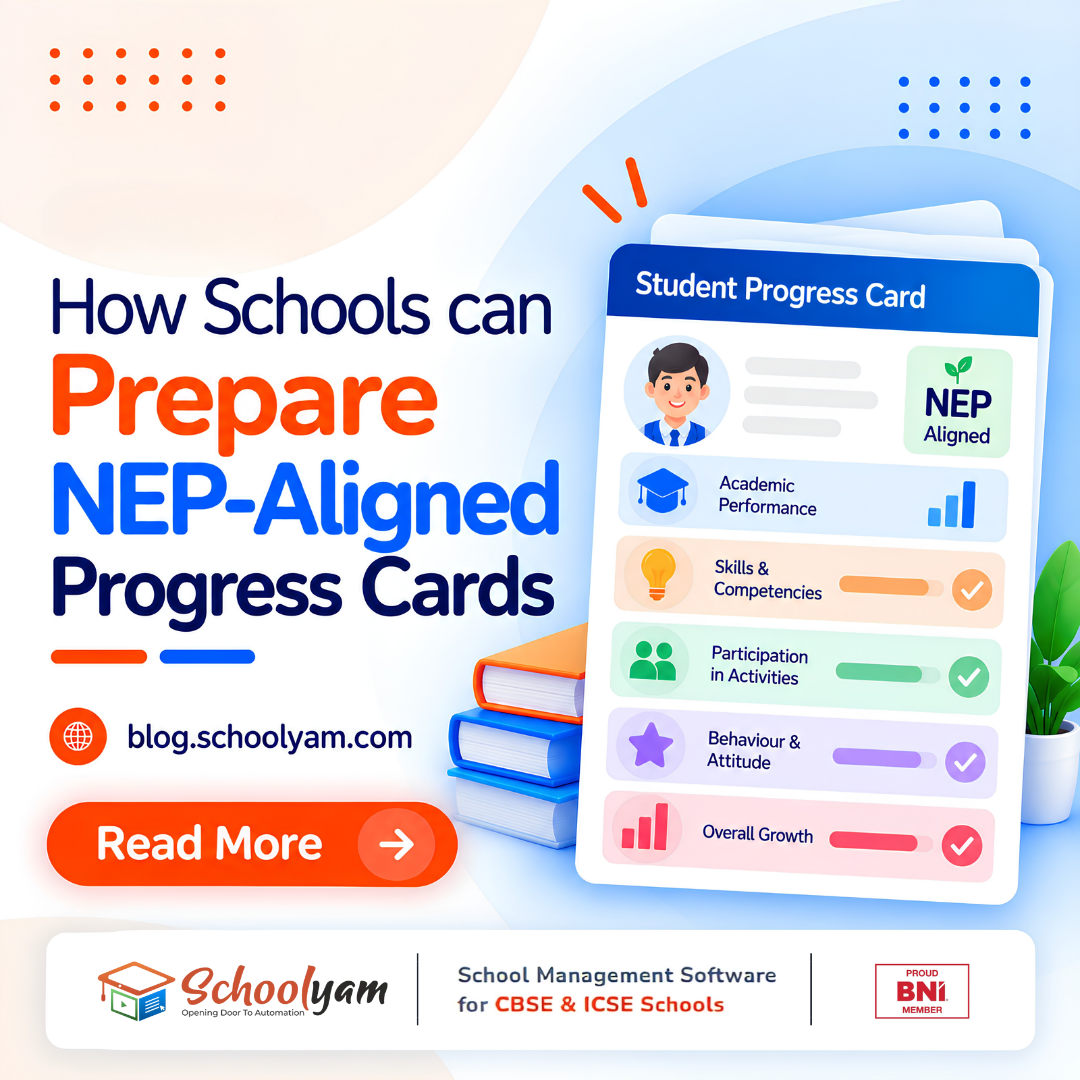
How Schools can Prepare NEP-Aligned Progress Cards . According to the National Education Policy (NEP) 2020, Schools are encouraged to move beyond marks-based evaluation and focus on a more Holistic view of Student Development.
For Schools, this means Progress Cards should reflect not only Academic Performance but also Skills, Competencies, Participation, and overall growth.
Here are some practical ways Schools can prepare NEP-aligned progress cards.
Progress Cards : Focus on Holistic Student Development
A NEP-aligned Progress Card should provide a broader picture of the learner. Along with academic performance, Schools can include areas such as:
- Communication skills
- Creativity
- Critical thinking
- Collaboration
- Participation in activities
- Social and emotional development
This helps Parents understand their child’s strengths beyond Examination Scores.
Pro Tip: Use a combination of Academic Performance, Skills, Activities, and Behavioural Observations to give a more complete picture of Student Development.
Include Competency-Based Assessment
Instead of focusing only on how many marks a student scored, schools should also consider what the Student can understand and Apply.
Teachers can assess Students through classroom Activities, Projects, Quizzes, Practical Work, and other Competency-based Assessments.
These observations can provide meaningful inputs for the progress card.
Pro Tip: Assess Students through Projects, Activities, Quizzes, and Practical Tasks to understand how effectively they can Apply what they have learned.
Track Progress throughout the Year
A comprehensive Progress Card should be based on continuous observation rather than a single examination.
Schools can maintain records of classroom performance, assessments, activities, projects, attendance, and learning progress throughout the academic session.
Regular tracking makes the final evaluation more meaningful and accurate.
Pro Tip: Record Student Performance and Observations throughout the Academic Session instead of relying only on Final Examination Results.
Make Progress Cards Easy for Parents to Understand
A progress card should communicate student development clearly.
Instead of presenting only numbers, schools can include Subject-wise Performance, Competency Indicators, Teacher Remarks, Strengths, and Areas for Improvement.
This allows Parents to understand where their child is doing well and where additional Support may be required.
Pro Tip: Use Clear Indicators, Teacher Remarks, Strengths, and Areas for Improvement so Parents can easily understand their Child’s Progress.
Use Digital Tools for Accurate & Faster Report Preparation
Preparing detailed Progress Cards manually can be Time-Consuming, especially when Schools need to combine information from multiple assessments.
A digital School Management system can help Teachers maintain assessment data, Calculate Results, organize Student Information, and generate Structured Progress Cards more efficiently.
Pro Tip: Maintain Assessment Data Digitally throughout the year so Progress Cards can be generated faster with fewer Manual Errors.
Conclusion
Preparing an NEP-aligned progress card requires Schools to look beyond marks and capture the Student’s broader Learning and Development.
A combination of continuous Assessment, Competency-based evaluation, meaningful Observations, and clear reporting can make Progress Cards more useful for Students, Teachers, and Parents.
Schoolyam helps 250+ Schools manage Academic Records, Assessments, Marks, and Report Cards digitally, making it easier to create structured and comprehensive Student Progress Reports.
Make Student Progress more meaningful, organised, and easier to understand with Schoolyam.
Call our School Automation Experts – 7080814044