Generating Report Cards is one of the most important academic tasks in every CBSE school. However, it can also be one of the most time-consuming and error-prone processes when done manually. From calculating marks and grades to preparing subject-wise results and adding teacher remarks, managing report cards requires accuracy and careful coordination.
A School ERP simplifies this entire process by automating report card generation, reducing manual work, and ensuring error-free results. Instead of spending days preparing report cards in Excel or on paper, schools can generate digital report cards within minutes.
For today’s CBSE schools, where academic data, continuous assessments, and digital communication have become essential, using a CBSE School ERP is no longer a luxury—it’s a practical necessity.
In this guide, we’ll explore how School ERP helps CBSE schools generate report cards, its benefits for teachers, school management, parents, and students, and the key features every school should look for.
What is a School ERP?
A School ERP (Enterprise Resource Planning) is a complete School Management Software that helps schools manage academic, administrative, financial, and communication tasks from a single platform.
Instead of maintaining multiple registers, Excel sheets, and separate software, schools can centralize everything in one system.
A modern CBSE School ERP typically manages:
- Student admissions
- Attendance
- Examination management
- Marks entry
- Report card generation
- Fee management
- Timetable
- Parent communication
- Staff management
- Student records
Among these features, report card generation is one of the biggest time-saving advantages for CBSE schools.
Why Report Card Generation is Challenging for CBSE Schools
Creating report cards may seem simple, but for schools with hundreds or thousands of students, it becomes a massive administrative task.
Let’s understand the common challenges.
Manual Marks Calculation
Many schools still collect marks from teachers using Excel sheets or handwritten records.
This creates problems like:
- Formula mistakes
- Missing marks
- Duplicate entries
- Incorrect totals
Even a small calculation error can affect a student’s final result.
Multiple Examinations
CBSE schools conduct several assessments throughout the academic year, such as:
- Periodic Tests
- Half-Yearly Exams
- Annual Exams
- Subject Enrichment Activities
- Internal Assessments
Combining all these scores manually requires significant effort and increases the chances of mistakes.
Subject-wise Grading
Different subjects may follow different grading structures.
Schools need to calculate:
- Marks
- Grades
- Percentage
- Overall performance
- Rank (if applicable)
Doing this manually for every student consumes valuable time.
Co-Scholastic Evaluation
CBSE schools also assess students beyond academics.
Teachers evaluate areas like:
- Discipline
- Art Education
- Health & Physical Education
- Life Skills
- Work Education
Managing these evaluations separately and then merging them into report cards adds another layer of complexity.
Attendance Integration
Attendance often needs to be reflected in report cards.
If attendance records are maintained separately, teachers have to manually update attendance percentages, which increases workload and the possibility of errors.
Teacher Workload
Teachers already spend considerable time on:
- Lesson planning
- Classroom teaching
- Assessments
- Parent meetings
- Administrative tasks
Preparing report cards manually leaves them with less time to focus on teaching and student development.
How School ERP Simplifies Report Card Generation
A CBSE ERP Software automates almost every step involved in creating report cards.
Let’s see how.
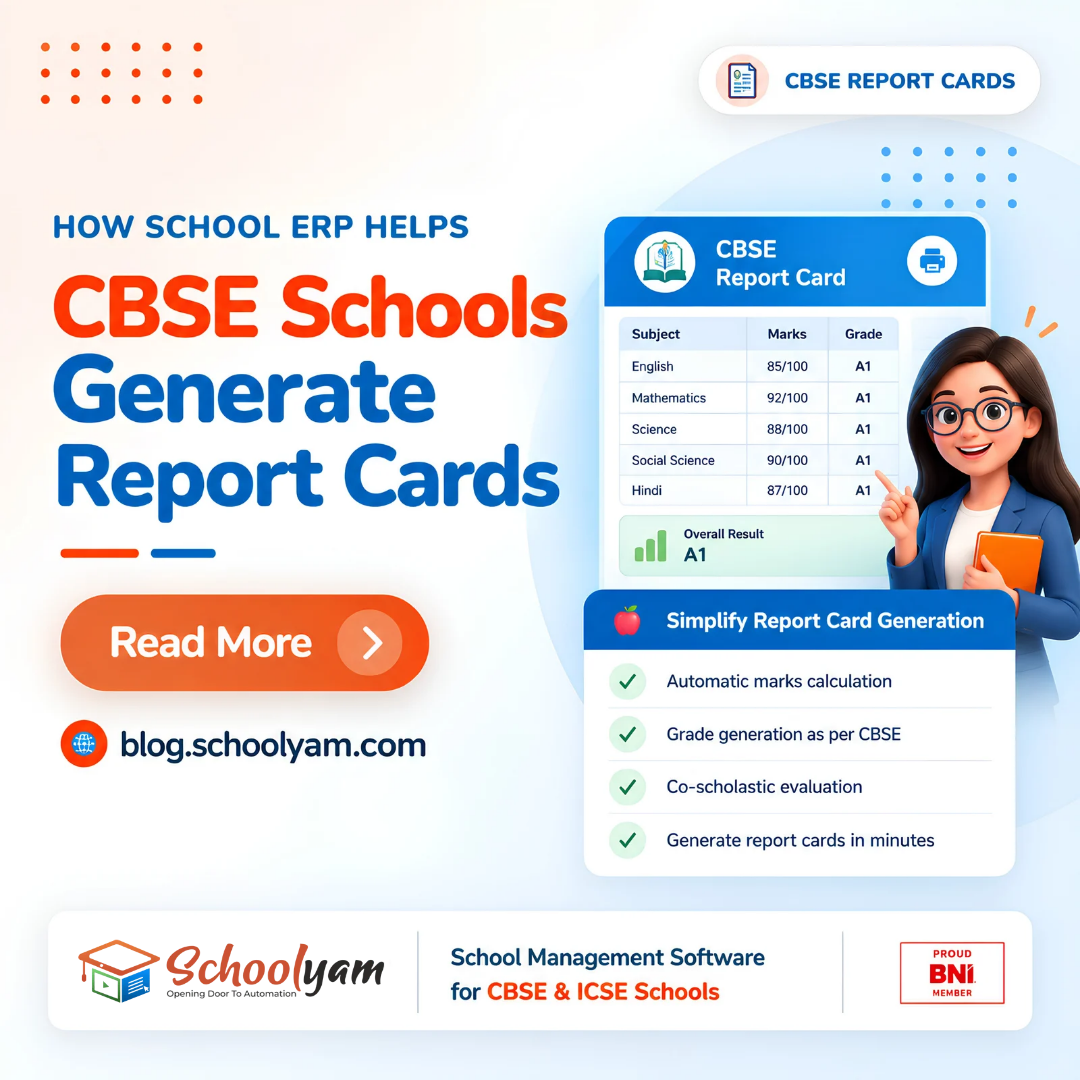
Automatic Marks Calculation
Teachers simply enter marks into the system.
The School ERP automatically:
- Calculates totals
- Computes percentages
- Applies grading rules
- Generates final results
This removes manual calculations and significantly reduces errors.
Automatic Grade Calculation
Instead of calculating grades one student at a time, the ERP automatically converts marks into grades based on the grading structure configured by the school.
This ensures consistency across all classes and sections.
Attendance Integration
Since attendance is already recorded within the ERP, the software automatically includes attendance details in the student’s report card.
There is no need for duplicate data entry.
Subject-wise Report Generation
The ERP organizes marks subject by subject, making report cards easier to read.
Each report card clearly displays:
- Subject names
- Marks obtained
- Maximum marks
- Grades
- Remarks
- Overall performance
Everything appears in a standardized format.
Co-Scholastic Assessment
Teachers can also enter co-scholastic evaluations directly into the system.
The ERP combines both academic and co-scholastic performance into one comprehensive Student Report Card, making the evaluation more complete and organized.
Teacher Remarks
Adding personalized remarks manually for every student can take hours.
Many modern Report Card Software solutions provide predefined remark templates that teachers can select and customize when needed. This saves time while still allowing meaningful feedback.
Instant PDF Report Cards
Once all marks are verified, the ERP generates professional-looking Digital Report Cards in PDF format.
Schools can:
- Print report cards
- Share them digitally
- Store them securely
- Re-download them anytime
This eliminates the hassle of maintaining paper copies.
Benefits of Using School ERP for Report Card Generation
Benefits for Teachers
Teachers are among the biggest beneficiaries of automation.
A School ERP helps teachers by:
- Reducing repetitive data entry
- Eliminating calculation errors
- Saving hours during result preparation
- Simplifying marks submission
- Generating report cards with just a few clicks
- Maintaining consistent grading across classes
Instead of spending weekends preparing report cards, teachers can focus more on improving student learning.
Benefits for School Management
School leaders need accurate academic records for effective decision-making.
A CBSE School ERP enables school management to:
- Monitor examination progress in real time
- Ensure standardized report card formats
- Reduce administrative workload
- Minimize human errors
- Access reports instantly
- Maintain centralized student records
- Improve operational efficiency
It also helps maintain better transparency across departments, making academic management smoother and more organized.
Benefits for Parents and Students
Parents no longer need to wait until Parent-Teacher Meetings to understand their child’s academic progress.
With a Digital Report Card, they can:
- View examination results online
- Track academic performance over time
- Monitor attendance
- Understand subject-wise strengths and improvement areas
- Stay informed through the parent portal or mobile app
Students also benefit by receiving timely feedback, helping them identify areas where they need to improve before the next assessment.
Features Every CBSE School ERP Should Have
Choosing the right ERP for Schools is important. While different software solutions offer different capabilities, some features are essential for effective academic management and report card generation.
A good CBSE School ERP should include:
- Report Card Generation with customizable templates
- Examination Management for scheduling and result processing
- Marks Entry with role-based access for teachers
- Attendance Management integrated with academic records
- Fee Management for streamlined financial operations
- Parent App for instant communication and result sharing
- Student Profiles with complete academic history
- Performance Analytics to identify trends and learning gaps
- Result Publishing through web portals or mobile applications
- Academic Management Tools for managing classes, subjects, and examinations from a single platform
These features not only simplify Report Card Generation but also improve overall School Automation and day-to-day administration.
Why CBSE Schools Are Moving Towards Digital Report Cards
The education sector in India is rapidly embracing digital transformation. Schools are increasingly replacing manual processes with technology to improve efficiency, accuracy, and accessibility.
One of the major reasons behind this shift is the growing emphasis on digital governance and streamlined academic administration. The vision of NEP 2020 also encourages the effective use of technology to enhance teaching, learning, assessment, and school management.
Digital report cards support this transformation by helping schools:
- Reduce paperwork and administrative burden
- Improve accuracy in academic records
- Generate results faster
- Store student data securely
- Share report cards instantly with parents
- Access historical records whenever required
- Support paperless school administration
For CBSE schools managing hundreds or even thousands of students, digital report cards are becoming the preferred approach because they save time, reduce operational costs, and improve the overall experience for teachers, administrators, parents, and students.
Frequently Asked Questions (FAQs)
What is a School ERP?
A School ERP is a complete School Management Software that helps schools manage academics, administration, examinations, attendance, fees, communication, and report cards from one centralized platform. It reduces manual work and improves efficiency across the school.
How does a School ERP generate report cards?
A School ERP automatically collects marks entered by teachers, calculates totals, percentages, and grades based on the school’s evaluation criteria, and generates a professional Student Report Card in just a few clicks. It also includes attendance, teacher remarks, and co-scholastic assessments.
Is a School ERP suitable for CBSE schools?
Yes. A CBSE School ERP is specifically designed to support the academic and administrative needs of CBSE-affiliated schools. It helps manage examinations, student records, attendance, report cards, and parent communication while simplifying day-to-day school operations.
Can report cards be generated automatically?
Yes. Once teachers enter marks and complete the required assessments, the Report Card Software automatically calculates results and generates Digital Report Cards. This significantly reduces manual effort and minimizes errors.
Is School ERP better than using Excel for report cards?
For most schools, yes. While Excel can work for smaller datasets, it becomes difficult to manage as student strength increases. A School ERP offers automatic calculations, centralized data, secure storage, standardized report formats, and easy access to historical records, making it a more efficient and reliable solution.
Can teachers generate report cards without technical knowledge?
Absolutely. Most modern CBSE ERP Software solutions are designed with user-friendly interfaces. Teachers can enter marks, review data, and generate report cards without requiring advanced technical skills or extensive training.
Does School ERP help reduce errors in report cards?
Yes. Since calculations, grade generation, and data compilation are automated, the chances of human errors are greatly reduced. This improves the accuracy and consistency of every CBSE Report Card.
Can parents access report cards online?
Yes. Most School ERP India solutions include a parent portal or mobile app where parents can securely view and download their child’s Digital Report Card, attendance records, examination results, and academic updates.
What features should a CBSE School ERP include?
A good CBSE School ERP should offer:
- Report Card Generation
- Examination Management
- Marks Entry
- Attendance Management
- Fee Management
- Parent Communication
- Student Profiles
- Performance Analytics
- Timetable Management
- Result Publishing
These features help schools improve efficiency and provide a better experience for teachers, students, and parents.
Why are digital report cards becoming popular in CBSE schools?
Digital report cards save time, reduce paperwork, improve data accuracy, and make academic records easier to access and share. They also support schools in adopting modern, technology-driven administrative practices and creating a more efficient academic environment.
Quick Summary
If you’re looking for a quick answer, here’s how a School ERP helps CBSE schools generate report cards:
- Automates marks calculation and grading
- Reduces manual errors
- Generates report cards within minutes
- Integrates attendance and examination records
- Supports co-scholastic evaluation
- Stores student records securely
- Enables easy result sharing with parents
- Saves teachers and administrators valuable time
- Improves academic transparency
- Supports digital school management
Conclusion
Preparing Report Cards is one of the most important responsibilities for any CBSE school. However, when handled manually, it often becomes a time-consuming process that increases the risk of calculation errors, inconsistent grading, and administrative delays.
A School ERP simplifies the entire workflow by automating Report Card Generation, managing examination data, calculating grades, integrating attendance, and maintaining student records in one centralized platform. This not only reduces the workload for teachers but also helps school management improve accuracy, efficiency, and transparency.
As more schools embrace digital transformation and modern academic practices, adopting a reliable CBSE School ERP has become an essential step toward smarter school management. Digital report cards are no longer just a convenience—they are becoming the standard for efficient and organized academic administration.
Platforms like Schoolyam are designed to support these evolving needs by helping CBSE schools manage report card generation, examination management, student records, attendance, fee management, parent communication, and academic planning through a single integrated system.
If your school is looking to simplify report card generation while improving overall academic management, exploring a comprehensive School ERP like Schoolyam can be a practical step toward a more efficient and digitally connected campus.
Final Thoughts
Technology cannot replace great teachers, but it can certainly reduce repetitive administrative work. When schools spend less time managing paperwork and more time focusing on teaching and learning, everyone benefits—teachers, students, parents, and the entire school community.
Investing in the right School Management Software today can help your school build a faster, more accurate, and future-ready academic ecosystem.